Coping with the Emotional Currents

Daily writing prompt
What’s the best way to deal with negative thoughts?

I am probably not the right person to answer this. People say you learn to handle things better over time, that practice makes you stronger. But in my case, the skill of dealing with negative thoughts has taken a downward trajectory. As a child, my approach was simple: I replaced negative thoughts with happy memories. That remains, to this day, the most effective tactic I’ve ever used. Since then, however, my strategies have spread like wildfire — often destructive rather than helpful.

Case in point: Strategy One — Compartmentalize and deal with it later. On the surface, this is a sound idea. I’ve learned to compartmentalize effectively, but the “deal with it later” part rarely happens. Instead, those compartments pile up. And there’s only so much space you can create before it all spills over, leading to an epic breakdown. I’ve had more than a few of those. You’d think I would have learned to process my bad thoughts at the right time, but that hasn’t been the case. Instead, I’ve scolded myself for being older now, telling myself I should simply be stronger.

Strategy Two — Analyzing the situation (or rather, overanalyzing). This one is even trickier. I start with the intention of figuring out what went wrong and how I can improve. But instead of constructive reflection, I turn cruelly critical. I list out, in excruciating detail, why I am the reason for everything wrong — not just in the situation, but in everything happening around me. That blame session drags on for days, until I’m mentally exhausted, and inevitably, another breakdown follows.

I don’t know if there’s a universally effective way to deal with negative emotions. I suspect it’s different for everyone. Some people probably use compartmentalizing and analyzing in healthy, productive ways. For me, though, the one thing that consistently works is writing. Whenever I feel overwhelmed, drowning in emotions, I grab a random piece of paper and pen and write it all down. The result is often depressing poems, but by the end, I feel lighter — as though a weight has lifted from my shoulders. Writing doesn’t solve the situation, but it acknowledges my feelings. And that acknowledgment makes all the difference.
Sleep

Daily writing prompt
What do you love now, that you hated when you were younger?

I can fall asleep almost anywhere. A moving car, the wind brushing against my face — that is when the sandman comes most swiftly. As a child, I hated it. One blink, and the journey was gone. No sights, no sounds, only the sudden arrival at the destination.

My parents kept a strict bedtime: 10 p.m. sharp. I resented it. After school, extra classes, activities, and homework, there was barely a sliver of time left for TV. By the time the books were closed, dinner was served, and then — lights out.

I never imagined there would come a day when I would long for sleep. It began in college, buried under syllabi, assignments, and a thesis with little guidance. Deadlines demanded sacrifice, and sleep was the first offering. Then came work. Freedom in earning, yes — but responsibilities multiplied. The corporate hamster wheel spun endlessly, and sleep became conditional: finish the job, or risk losing it.

Now I crave not just sleep, but sleep with dreams. Four or five hours a night leave me chasing rest wherever I can find it. Sometimes I take a cab to the office just to steal a nap in the back seat, while the driver carries me through the city.

It is true what they say: children never understand the joy of sleep. I didn’t either. But now I know — sleep is not punishment. Sleep is mercy. Sleep is gift.

Day 211: Finding my Independence

Being the younger child in the family comes with a lot of privileges, but it also comes with its challenges. While I am extremely pampered because my parents literally want to do everything for me, they do not set high expectations because they don’t want me to feel burdened. They are always happy with whatever I achieve, no matter how insignificant it is.

I have now come to a stage in my life where I want to live independently. I want to have my own home — and yes, my parents’ home will always be my home. But being the younger child often means your opinions or choices are not really considered. I think I want a home of my own not for the freedom that comes with it, but because I want to decorate it the way I like. I want to finally be able to buy furniture that I love. I want to have my own office room that I can set up according to my preference, without someone constantly asking, “Do you really need this? Why this? Why that?” And of course, I want to walk around my house in the clothes I like. Since I’ll essentially be by myself, I doubt relatives will visit often, and there will be no judgment on how I look.

While the prospect of living separately excites me, it also brings with it the guilt tied to the “empty nest syndrome.” I sometimes just stare at my parents doing their regular tasks and notice the shift in the way they move. They have become slower. They have become quieter. They spend most of their days just resting, ironically scrolling through the phone or watching TV. I see them huffing and letting out exasperated sighs when they take a break after doing some tasks. They are together now, but I keep thinking: should one of them leave, how will the other manage? Would it be right for me to leave them too?

But on the other hand, I’ve received very fitting advice: “You can love and care for them, but it is not your responsibility to fix their life.” It is true — parents are the most resilient class of people. Their world keeps changing, and somehow they adapt. They may not adapt in the way you believe is right, but they find a way to adjust to their new life.

And so, I return to my desire to finally break free from the nest and find a place of my own in this world.

Insides Intuition

Daily writing prompt
What’s a time you followed your gut and it turned out to be exactly right?

For most of my life, intuition felt like a mystery. People spoke about “gut feelings” as if they were natural guides, but for me, thinking on my feet was never my strength. I second‑guessed myself constantly, replayed situations in my head, and often realized too late that I’d missed the emotional undercurrents of what was happening.

That pattern had consequences. In one relationship, my first instinct told me something was wrong. But instead of listening, I doubted myself. I convinced myself that maybe I was the problem, and in doing so, I stayed far longer in a toxic situation than I should have. My hesitation to trust my gut became a trap.

Over time, though, I began to notice something important: those initial instincts weren’t random. They were signals. When I ignored them, I regretted it. When I honored them, I avoided unnecessary pain. Now, whenever I get that uneasy feeling, I give myself permission to walk away. I don’t let the sword of “you may regret this” scare me into suppressing my feelings and making choices that would eventually hurt me.

The difference has been profound. Trusting my intuition has helped me sidestep decisions that would have drained me, and it’s given me a sense of confidence I didn’t have before. It doesn’t mean I act impulsively; it means I respect the quiet voice inside me that says, “This isn’t right.”

Intuition isn’t magic — it comes from experience and paying attention to the world around you. For me, learning to trust it has been a journey of reclaiming self‑respect. Now, when my gut tells me something’s off, I listen. And more often than not, it’s the best decision I can make.

Happily Ever After

Daily writing prompt
What’s something you used to believe as a kid that seems ridiculous now?

We grow up surrounded by Disney movies and teen rom-coms that promise us neat endings. The protagonist faces heartbreak, stumbles through challenges, and then almost magically everything falls into place. Success, love, and a perfect life all right on cue. But real life doesn’t roll the credits after the happy ending. It keeps going, with new struggles waiting just around the corner.

Life is rarely a straight path to happiness. Some days we fall and don’t get back up right away. We feel drained, exhausted, and overwhelmed, as if the world is crashing down. Yet, when we muster the courage to rise again, we taste fleeting victories — moments that remind us why we keep trying. But soon enough, another challenge appears, and the cycle begins again. Happiness isn’t permanent; it’s a series of short-lived sparks. The trick is to hold onto those sparks, to cherish them, and to share them with the people we love. When their days feel heavy, we can offer them moments of light, just as they do for us. These exchanges of joy are what make the struggle worthwhile.

If life were always happy, we’d stop appreciating it. It’s the contrast, the bitter alongside the sweet that gives happiness its meaning. The setbacks sharpen our gratitude for the good days. The heartbreaks make love more precious. The failures make success more satisfying. I may never get the “happily ever after” promised in the movies. But I’ve learned that life isn’t about one grand ending. It’s about finding happiness in the everyday — in laughter, in resilience, in love, and in the courage to keep trying.

The Notes of Change

Daily writing prompt
What’s a piece of media (book, movie, song) that changed how you see the world?

usic has always been present in my life. My mother sang in the choir, and my sister was blessed with a soulful voice. By the time I was six, I too joined the choir — and from the very first note, I loved singing.

At around ten or eleven, I began to pay attention not just to melodies but to the lyrics. That shift changed everything. Music was no longer just something I enjoyed when I was happy; it became something I deeply related to when I was upset.

The first song that has truly impacted me is “Seasons in the Sun”. Its farewell theme, filled with memories and goodbyes, resonated so strongly that I often cried when I heard it. Beyond its sadness, the song reminds us of the fragility of life and the importance of cherishing the people around us. In everyday life, it teaches me to value moments with family and friends, because time is never guaranteed. Sometimes it’s the words left unsaid that matter most, and this song pushes me to express love openly before it’s too late.

Another song that has stayed with me since childhood is “Walking Away”. Its laid-back tone contrasts with its powerful message about leaving behind toxic people and situations. It’s not just about endings; it’s about courage — the strength to step away from what no longer serves you. In daily life, this resonates whenever I face difficult choices, reminding me that peace often comes from letting go rather than holding on. It reassures me that seeking space isn’t selfish; it’s self-preservation, a necessary act of survival in a world that can be cruel.

Life has shifted in countless ways: genres, artists, circumstances. Yet one thing has remained constant — music. In times of turmoil, it brings me comfort and peace. Whether through melancholic songs that let me sit with my emotions or uplifting tracks that reignite my energy, music adapts to my journey and never leaves my side.

Music is more than sound; it’s memory, emotion, and healing. It has been my mirror when I needed to reflect and my lantern when I needed light. No matter what changes, music remains my most faithful companion — guiding me through everyday life with lessons of love, resilience, and hope.

No Unsolicited advice

Daily writing prompt
What’s the best advice you’d give to someone younger than you?

The one thing I have learned is never to give advice where it isn’t asked. When I was younger, I never understood the point of view of those who tried to advise me. Over time, I realized that experience is the only way you truly learn to accept advice.

Don’t say, “Stay away from the fire.” Instead, say, “I got burnt, but if you still want to touch the fire, it’s up to you.” Rather than offering advice, the one thing I would tell someone is: “I am here if you need me. I’ll help you get back up if you ever fall.” or “I don’t condone what you’re doing, but I’ve got your back.”

More than anything, what my younger self needed was support. And in today’s world, I believe that support is more important than ever. With all the criticism the world throws at you — often without considering the impact it can have — life can feel cruel.

If there’s one piece of advice I would give, with the hope that anyone would listen, it’s this: “Don’t judge. It hurts more than a knife ever could.”

In the end, we don’t always need someone to tell us what to do — we need someone to remind us that we are not alone. Support, kindness, and understanding are the bridges that carry us through the fire and back into the light.

Day 205: Small step but still a start

Today was, all in all, an uneventful day. I woke up considerably early, though I still didn’t manage to get my six hours of sleep. I lay in bed for an hour, scrolling through Instagram shorts before finally convincing myself to get up and begin.

I started my work with enthusiasm, but of course today had to be the day my laptop decided to give up on me. The system ran so slowly that it was frustrating to refresh the screen over and over just to load a single page. I made myself a cup of coffee, hoping it would give me the energy I needed to push through.

Later, I found myself guilty of indulging in online browsing. What do you even call the equivalent of window shopping when it’s done online? Whatever the name, that’s exactly what I did. I didn’t buy anything, thankfully, but I did add a few things to my cart that I’m still tempted to purchase. It took everything in me to stop myself from checking out and to close the website.

Despite the distractions, I managed to complete the work assigned for the day. I finished my calls and meetings, completed my trainings, and wrapped everything up within the timeline. I finally switched off my office laptop. Now I am hoping to put sometime into studying, the thing I have put off for as long as possible.

It wasn’t a perfect day. But it was a start. And sometimes, a start is enough.

Inspirations

Daily writing prompt
Who are you most inspired by?

As a child, I probably would have named a famous person as my inspiration — someone the world had already deemed successful. Ironically, I don’t even remember those childhood idols anymore.

Today, my inspirations are not people themselves, but rather their actions. You don’t have to achieve great things in life. You don’t have to be famous or popular. A person can be an inspiration simply by standing up for what is right. A child defending a friend against bullies, a parent protecting their child’s dignity when others condemn them for low grades, a job seeker walking into an interview after being laid off, a girl demanding her right to education, a survivor holding their head high despite society’s judgment — each of these moments carries a quiet, powerful courage.

In those moments, they become an inspiration because of their pure moral strength. Their courage to keep fighting, to keep moving forward, matters more than physical strength or accolades. And in that moment, they give someone else the courage to stand up too — to face the odds, to keep fighting, even if success doesn’t come right away.

We all have weaknesses. Some are born from the people around us who broke our tiny dreams. Others come from self-doubt and criticism that tie us down, clipping the wings we once had as children. But inspiration is not about perfection. It’s about persistence. It’s about refusing to let those wounds define us.

I draw inspiration from the great actions of ordinary people I see every day. Their courage reminds me that inspiration doesn’t live in fame or fortune — it lives in the quiet strength of those who keep moving forward, no matter the odds. Inspiration is not a pedestal. It’s a spark. And sometimes, the smallest acts of courage light the brightest flames.

Teach you a Lesson

Rating: 3.5 out of 5.

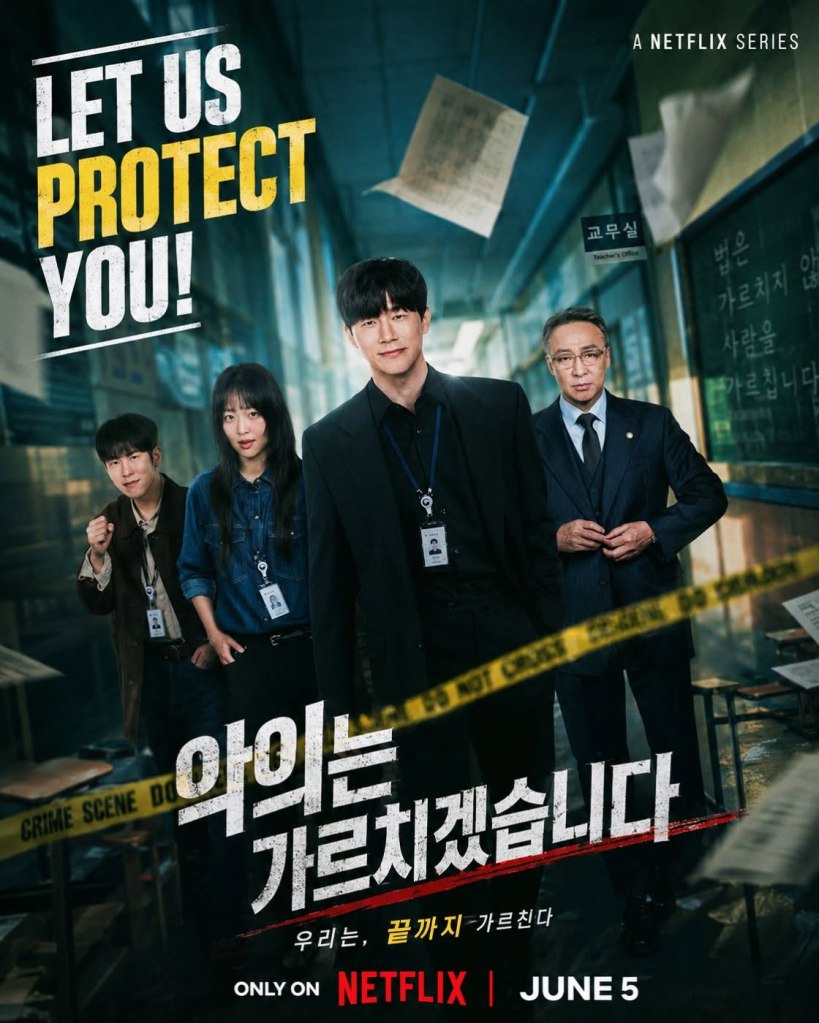
The Netflix series is adapted from the Naver webtoon Get Schooled which takes a bold look at the failures of Korea’s education system and the troubling leniencies given to juvenile offenders. In Korea, young offenders often receive lighter punishments due to their age, a loophole that has drawn many teenagers and young adults into crime. The series dramatizes this issue through the creation of the fictional Educational Rights Protection Board (ERPB), an agency formed after the tragic death of a teacher at the hands of a student. Its mission is to reform schools so that students can thrive regardless of their backgrounds, while ensuring that offenders are held accountable for the harm they cause.

Led by Education Minister Choi Gangseok, the ERPB team—Na Hwajin, Im Harim, and Bong Geundae—travels across the country to confront problematic schools. Their approach is uncompromising, using every method available to “straighten out” troubled students and teachers while tackling the root causes of dysfunction. This narrative highlights the importance of early intervention, showing that shaping children’s minds at the right age can prevent destructive adult behavior and, ultimately, reshape society.

The series is compelling in its social critique and gripping in its drama, but it leaves viewers wanting more depth in the characters’ backstories. While the focus on systemic reform is powerful, the show misses opportunities to explore how each ERPB member’s own school experiences shaped their moral drive to fix the system. I think that if there were more detailed flashbacks to their personal struggles of the team members could have added emotional resonance and made the characters more relatable. It feels as though the 10-episode format constrained the storytelling, prioritizing the reform narrative over character development and limiting its ability to connect deeply with viewers.

Despite these limitations, Get Schooled is definitely worth watching. It offers a refreshing take on education as crime prevention and demonstrates that the right actions taken at the right time can transform not just individuals but society as a whole.